Events
September 21, 2026 - 4pm, TRIO Building 66 Ground Floor
ICCB Seminar Series on Computational Cancer Biology - Peter Van Loo, PhD
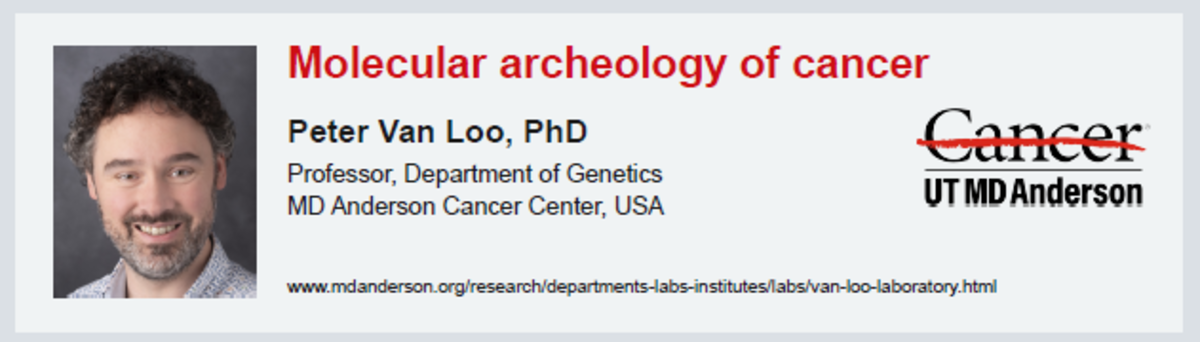
Peter will talk about the Molecular archeology of cancer
Abstract
The cancer genome carries an archeological record of the tumor’s past. Over the past years, we have developed several approaches to mine that archeological record, which we collectively call 'molecular archeology of cancer'. Using these approaches, we are able to infer the subclonal architecture and evolutionary history of tumors. We applied these approaches in a largescale pancancer setting, showing that intratumor heterogeneity is pervasive across cancers and that the timelines of tumor evolution span multiple years to decades. Key driver events in tumor evolution typically occur early, and copy number gains often accumulate as punctuated bursts, commonly after genome doubling. Late genome doubling is frequent in cancer evolution and is typically followed by an increase in chromosomal instability. Our approaches increase the evolutionary information that can be obtained from tumor genome sequences and, therefore, improve our understanding of the developmental history of cancer.
About the speaker
Peter Van Loo is a Professor and CPRIT s holar at the University of Texas MD Anderson Cancer Center, Department of Genetics, with a joint appointment at the Department of Genomic Medicine. During his postdoc, Peter developed computational techniques to study copynumber alterations in cancer genomes and the evolutionary history and subclonal architecture of tumors. As an independent researcher, at the Francis Crick Institute in London, and later as a professor at the University of Texas MD Anderson Cancer Center, he has sketched the typical evolutionary trajectories of many cancer types, allowing insight into the timelines of cancer development and into how tumors metastasize.
Contact: Laura Godfrey (+49 221 478 51455, laura.godfrey@iccb-cologne.org), Stefanie Fleer (+49 221 478 15104, stefanie.fleer@iccb-cologne.org)
June 12, 2026 - 2pm, TRIO Building 68, Seminar Room, Ground Floor
ICCB Seminar Series on Computational Cancer Biology - Special Edition: EU AI Act and its implications for data science and biomedical data

What does the EU AI Act mean for your biomedical research and your data?
The EU AI Act introduces a comprehensive regulatory framework that will directly affect the development, validation, deployment, and use of AI in research.
Join us for a legal perspective and its relevance for researchers by Leander Heine, DAX40 in-house lawyer advising on AI and data protection.
We will cover the following topics:
- General Data Protection Regulation (GDPR)
- EU AI Act
- Implications for data science and biomedical data
Contact: Laura Godfrey (+49 221 478 51455, laura.godfrey@iccb-cologne.org), Stefanie Fleer (+49 221 478 15104, stefanie.fleer@iccb-cologne.org)
February 20, 2026 - 1pm, Zoom
ICCB Seminar Series on Computational Cancer Biology & Epi-Club - Professor Ana Pombo

Ana will talk about Spatial 3D Genomics: from mammalian chromosome structure to ecological microbiota relationships
About the speaker
Ana Pombo studied Biochemistry at the University of Lisbon, Portugal. Afterwards, she obtained her PhD from the Sir William Dunn School of Pathology, University of Oxford, where she described transcription factories in the mammalian nucleus. She stayed as a Royal Society Dorothy Hodgkin Fellow before starting her own group at the Imperial College London in 2000. In 2013, Pombo moved her lab to Berlin, becoming a senior group leader at the Berlin Institute for Medical Systems Biology at the Max Delbrück Center for Molecular Medicine (MDC) in Berlin-Buch with the focus on "Epigenetic Regulation and Chromatin Architecture". Now she is a research professor in the Department of Biology at the John Hopkins University in Baltimore. Ana is an elected member of the European Molecular Biology Organization (EMBO). Her work was awarded with the Leibniz Prize in 2025.
January 13, 2026 - 11am, CIO Building 70, Seminar Room 1/2, Ground Floor
ICCB Seminar Series on Computational Cancer Biology - Helena Kilpinen, PhD

Helena will talk about Joint profiling of cell morphology and gene expression in neuronal disease models
Abstract
Differentiation of induced pluripotent stem cells (iPSC) towards neuronal lineages has enabled diverse cellular models of human neurodevelopment and related disorders. While mutations in genes encoding for epigenetic regulators are an established cause for neurodevelopmental disorders (NDD), their exact molecular mechanisms remain unknown and there is a need for systematic phenotyping of in vitro neurons at scale. We have used Cell Painting, a high-content imaging assay, jointly with transcriptomic profiling in single cells to characterize the biological heterogeneity in developing cortical neurons. We observed that image-based morphological phenotypes enhanced our ability to quantify the biological processes that determine neuronal differentiation outcomes over time and allowed us to identify disease-relevant phenotypes.
About the speaker
Helena Kilpinen is a tenure-track associate professor in human genetics and genomic medicine at Helsinki Institute of Life Science (HiLIFE) at the University of Helsinki (UH) in Finland and the Faculty of Medicine, and a group leader at FIMM and the Neuroscience Center. Her lab investigates the cellular genetics and the cellular basis of developmental and other brain-related disorders using human induced pluripotent stem cells (iPSC) as models, and combine computational and experimental methods.
Contact: Laura Godfrey (+49 221 478 51455, laura.godfrey@iccb-cologne.org), Stefanie Fleer (+49 221 478 15104, stefanie.fleer@iccb-cologne.org)
November 14, 2025 - 10 am to 5 pm, TRIO Building 66 Ground Floor
ICCB Workshop: Reproducibility for Big Data Science

Join our third iteration of our workshop to take your Git, Conda and Docker skills to the next level!
While this workshop is suitable for beginners and advanced users alike, explicit focus is placed on advanced usage of aforementioned tools to make your research more efficient and reproducible. Each of the three blocks will be presented in a dedicated, interactive session. Finally, participants will use the learned skills in a practical hands-on project.
Ideally, you are already familiar with basic shell usage (commands like ls, grep, rm, etc. no longer scare you) and basic git commands (add, commit, push, pull, etc.). You know what a Dockerfile is, you may have even heard of docker-compose and have pulled and ran a docker image before.
You do not tick all the boxes? Do not be discouraged! Most importantly, you should bring curiosity, the willingness to learn and to ask questions.
We will cover the following topics:
- Software development in largerscale projects using Git
- Package management with CondaWe will cover the following topics:
- Application management with Docker including continuous integration (CI), setting up and using runners
Prerequisites:
- Basic Linux command line knowledge (e.g. commands as ls, grep, cd, etc.)
- Working installations of Git, Conda and Docker Desktop as well as your favorite IDE
- Basic knowledge of python as well as common libraries (pandas, numpy, matplotlib)
Participants from our second workshop in February are very welcome!
If you are interested please register until 02nd of November 2025.
October 27, 2025 - 3 pm, TRIO Building 66 Ground Floor
ICCB Seminar Series on Computational Cancer Biology - Maxime Tarabichi, PhD

Maxime will talk about Unfolding the somatic genome evolution of human cancers from fertilisation to resection
Abstract
Genomes in our cells start to evolve from the initial genomes of our parents and accumulate somatic mutations. Most of these are silent or will not lead to malignant growth. We study how different classes of somatic changes, including single nucleotide substitutions and copy-number changes, accumulate over time on the parental genomes.
About the speaker
Maxime Tarabichi is Associate Professor IRIBHM Jacques E. Dumont, Université Libre de Bruxelles in Belgium. His lab investigates the somatic and cancer genome evolution of different tissues, including in the context of sarcomas and thyroid cancers.
Contact: Laura Godfrey (+49 221 478 51455, laura.godfrey@iccb-cologne.org), Stefanie Fleer (+49 221 478 15104, stefanie.fleer@iccb-cologne.org)
August 18, 2025 - 11 am, TRIO Building 66 Ground Floor
ICCB Seminar Series on Computational Cancer Biology - Prof. Niko Beerenwinkel

Niko will talk about Modeling tumor progression from single-cell sequencing data
Abstract
Cancer progression is an evolutionary process characterized by the accumulation of genetic alterations and responsible for tumor growth, clinical progression, and drug resistance development. He will discuss (1) how to reconstruct the evolutionary history of a tumor from single-cell sequencing data and present probabilistic models and efficient inference algorithms for mutation calling and learning tumor phylogenies from mutation and copy number data, and (2) how tumor phylogenies enable integrating single-cell DNA and RNA data obtained from tumor biopsies, finding common patterns of tumor evolution among patients, and inferring the underlying cellular fitness landscape of cancer evolution.
About the speaker
Niko Beerenwinkel is Full Professor of Computational Biology at the Department of Biosystems Science and Engineering of ETH Zurich in Basel. His research is at the interface of mathematics, statistics, and computer science with biology and medicine. It includes statistical, evolutionary, and network modeling of molecular profiling data. He has developed several computational methods for supporting molecular diagnostics in oncology and virology, including for the analysis of tumor singlecell genomics data and of deep sequencing data obtained from virus populations.
Contact: Laura Godfrey (+49 221 478 51455, laura.godfrey@iccb-cologne.org), Stefanie Fleer (+49 221 478 15104, stefanie.fleer@iccb-cologne.org)
June 17, 2025 - 11 am, TRIO Building 66 Ground Floor
ICCB Seminar Series on Computational Cancer Biology - Prof. Johannes Köster

Johannes will talk about Generic Solutions for Specific Problems in Genomics: Snakemake, Datavzrd, and Varlociraptor in 2025
Abstract
At the example of the successful open source projects Snakemake, Datavzrd, and Varlociraptor, I outline the development of continuously maintained, tested, and improved software solutions that arose from the necessity to solve at first sight rather specific and narrowly scoped bioinformatics problems. I describe the generalization steps and demonstrate how this approach enhanced their sustainability, leading to their current feature sets and ongoing advancements.
About the speaker
Johannes Köster is professor for Bioinformatics and Computational Oncology at the Institute for AI in Medicine (IKIM), University Medicine Essen, University of Duisburg-Essen with a focus on algorithm engineering and data analysis. Johannes studied computer science at the University of Dortmund. Johannes' research is focused on reproducibility in three ways. First, he is the author of the popular workflow management system Snakemake and the founder of the Bioconda project for sustainably distributing bioinformatics software as easily installable packages. Second, Johannes is the author of the Rust-Bio library, enabling the use of the Rust programming language for bioinformatics by providing standard bioinformatics algorithms and data structures. Third, Johannes is working in the field of Bayesian statistics (e.g., for variant calling and single cell transcriptomics) in order to provide algorithms for analysis of highthroughput data while capturing and quantifying all known sources of uncertainty, thereby providing more reproducible predictions.
Contact: Laura Godfrey (+49 221 478 51455, laura.godfrey@iccb-cologne.org), Stefanie Fleer (+49 221 478 15104, stefanie.fleer@iccb-cologne.org)